Khóa học
IELTS Online
IELTS Online
Giảm đến 18%
Đăng ký ngay
Mục lục [Ẩn]
Khi ôn tập IELTS Reading, việc luyện kĩ năng giải đề qua các đề thi thật là một cách hiệu quả giúp bạn tăng band điểm nhanh. Bài viết này sẽ giúp bạn giải trọn vẹn đề thi thật IELTS Reading “Why being bored is stimulating” với đầy đủ đề bài, câu hỏi, đáp án chi tiết kèm giải thích rõ ràng. Đây sẽ là tài liệu hữu ích để bạn ôn luyện và nâng cao kỹ năng Reading, sẵn sàng chinh phục band điểm mục tiêu trong kỳ thi IELTS.
Why being bored is stimulating
Paragraph A
We all know how it feels – it’s impossible to keep your mind on anything, time stretches out, and all the things you could do seem equally unlikely to make you feel better. But defining boredom so that it can be studied in the lab has proved difficult. For a start, it can include a lot of other mental states, such as frustration, apathy, depression and indifference. There isn’t even agreement over whether boredom is always a low-energy, flat kind of emotion or whether feeling agitated and restless counts as boredom, too. In his book, Boredom: A Lively History, Peter Toohey, at the University of Calgary, Canada, compares it to disgust – an emotion that motivates us to stay away from certain situations. ‘If disgust protects humans from infection, boredom may protect them from “infectious” social situations,’ he suggests.
Paragraph B
By asking people about their experiences of boredom, Thomas Goetz and his team at the University of Konstanz in Germany have recently identified five distinct types: indifferent, calibrating, searching, reactant and apathetic. These can be plotted on two axes – one running left to right, which measures low to high arousal, and the other from top to bottom, which measures how positive or negative the feeling is. Intriguingly, Goetz has found that while people experience all kinds of boredom, they tend to specialise in one. Of the five types, the most damaging is ‘reactant’ boredom, with its explosive combination of high arousal and negative emotion. The most useful is what Goetz calls ‘indifferent’ boredom: someone isn’t engaged in anything satisfying but still feels relaxed and calm. However, it remains to be seen whether there are any character traits that predict the kind of boredom each of us might be prone to.
Paragraph C
Psychologist Sandi Mann at the University of Central Lancashire, UK, goes further. ‘All emotions are there for a reason, including boredom,’ she says. Mann has found that being bored makes us more creative. ‘We’re all afraid of being bored, but in actual fact, it can lead to all kinds of amazing things,’ she says. In experiments published last year, Mann found that people who had been made to feel bored by copying numbers out of the phone book for 15 minutes came up with more creative ideas about how to use a polystyrene cup than a control group. Mann concluded that a passive, boring activity is best for creativity because it allows the mind to wander. In fact, she goes so far as to suggest that we should seek out more boredom in our lives.
Paragraph D
Psychologist John Eastwood at York University in Toronto, Canada, isn’t convinced. ‘If you are in a state of mind-wandering, you are not bored,’ he says. ‘In my view, by definition, boredom is an undesirable state.’ That doesn’t necessarily mean that it isn’t adaptive, he adds. ‘Pain is adaptive – if we didn’t have physical pain, bad things would happen to us. Does that mean that we should actively cause pain? No. But even if boredom has evolved to help us survive, it can still be toxic if allowed to fester.’ For Eastwood, the central feature of boredom is a failure to put our ‘attention system’ into gear. This causes an inability to focus on anything, which makes time seem to go painfully slowly. What’s more, your efforts to improve the situation can end up making you feel worse. ‘People try to connect with the world, and if they are not successful, they experience frustration and irritability,’ he says. Perhaps most worryingly, says Eastwood, repeatedly failing to engage attention can lead to a state where we don’t know what to do any more and no longer care.
Paragraph E
Eastwood’s team is now trying to explore why the attention system fails. It’s early days but they think that at least some of it comes down to personality. Boredom proneness has been linked with a variety of traits. People who are motivated by pleasure seem to suffer particularly badly. Other personality traits, such as curiosity, are associated with a high boredom threshold. More evidence that boredom has detrimental effects comes from studies of people who are more or less prone to boredom. It seems those who bore easily face poorer prospects in education, their career and even life in general. But of course, boredom itself cannot kill – it’s the things we do to deal with it that may put us in danger. What can we do to alleviate it before it comes to that? Goetz’s group has one suggestion. Working with teenagers, they found that those who ‘approach’ a boring situation – in other words, see that it’s boring and get stuck in any way – report less boredom than those who try to avoid it by using snacks, TV or social media for distraction.
Paragraph F
Psychologist Francoise Wemelsfelder speculates that our over-connected lifestyles might even be a new source of boredom. ‘In modern human society, there is a lot of overstimulation but still many problems finding meaning,’ she says. So, instead of seeking yet more mental stimulation, perhaps we should leave our phones alone and use boredom to motivate us to engage with the world in a more meaningful way.

Questions 14–19
Reading Passage 2 has six paragraphs, A–F.
Choose the correct heading for each paragraph from the list of headings below.
Write the correct number (i–viii) in boxes 14–19 on your answer sheet.
List of Headings
i. The productive outcomes that may result from boredom
ii. What teachers can do to prevent boredom
iii. A new explanation and a new cure for boredom
iv. Problems with a scientific approach to boredom
v. A potential danger arising from boredom
vi. Creating a system of classification for feelings of boredom
vii. Age groups most affected by boredom
viii. Identifying those most affected by boredom
14. Paragraph A
15. Paragraph B
16. Paragraph C
17. Paragraph D
18. Paragraph E
19. Paragraph F
Questions 20–23
Look at the following people (Questions 20–23) and the list of ideas below.
Match each person with the correct idea (A–E).
Write the correct letter A–E in boxes 20–23 on your answer sheet.
List of Ideas
A. The way we live today may encourage boredom.
B. One sort of boredom is worse than all the others.
C. Levels of boredom may fall in the future.
D. Trying to cope with boredom can increase its negative effects.
E. Boredom may encourage us to avoid an unpleasant experience.
20. Peter Toohey
21. Thomas Goetz
22. John Eastwood
23. Francoise Wemelsfelder
Questions 24–26
Complete the summary below.
Choose ONE WORD ONLY from the passage for each answer.
Write your answers in boxes 24–26 on your answer sheet.
Responses to boredom
For John Eastwood, the central feature of boredom is that people cannot 24 ______, due to a failure in what he calls the ‘attention system’, and as a result, they become frustrated and irritable. His team suggests that those for whom 25 ______ is an important aim in life may have problems in coping with boredom, whereas those who have the characteristic of 26 ______ can generally cope with it.
>>> XEM THÊM:
Đề thi IELTS Reading có đáp án mới nhất 2025-2026 [Cập nhật liên tục]
Giải đề Back to the future of skyscraper design [Cam IELTS 14, Test 2]
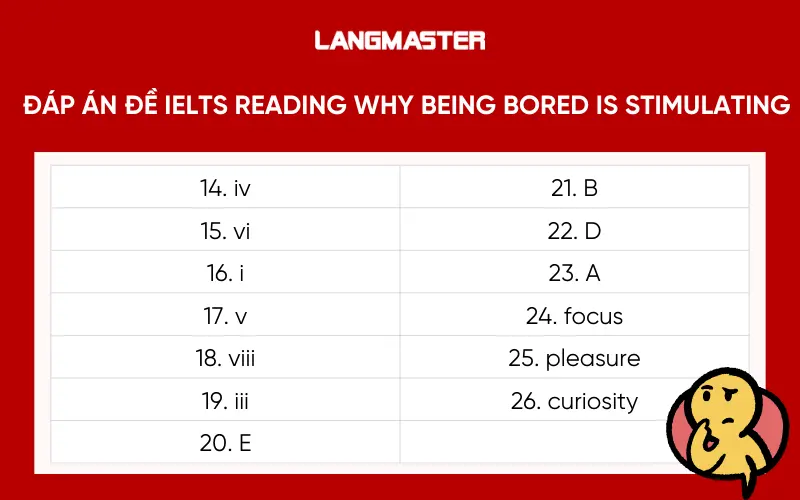
Dưới đây là bảng đáp án để bạn đối chiếu:
|
14. iv |
21. B |
|
15. vi |
22. D |
|
16. i |
23. A |
|
17. v |
24. focus |
|
18. viii |
25. pleasure |
|
19. iii |
26. curiosity |
|
20. E |
|
Đáp án chi tiết 14 - 19
14. Paragraph A → iv. Problems with a scientific approach to boredom
Trích đoạn: “But defining boredom so that it can be studied in the lab has proved difficult.”
Dịch: “Nhưng việc định nghĩa sự nhàm chán để có thể nghiên cứu nó trong phòng thí nghiệm đã chứng minh là rất khó.”
Giải thích: Đoạn A tập trung nói rằng rất khó nghiên cứu boredom theo cách khoa học, vì:
khó định nghĩa
bao gồm nhiều trạng thái cảm xúc khác nhau
các nhà nghiên cứu còn chưa thống nhất
=> Phù hợp với heading Problems with a scientific approach to boredom.
15. Paragraph B → vi. Creating a system of classification for feelings of boredom
Trích đoạn: “Thomas Goetz and his team … have recently identified five distinct types.”
Dịch: “Thomas Goetz và nhóm của ông gần đây đã xác định năm loại nhàm chán khác nhau.”
Trích đoạn tiếp: “These can be plotted on two axes – one running left to right, which measures low to high arousal, and the other from top to bottom, which measures how positive or negative the feeling is.”
Dịch: “Những loại này có thể được biểu diễn trên hai trục – một trục đo mức độ kích thích từ thấp đến cao và trục còn lại đo mức độ cảm xúc tích cực hay tiêu cực.”
Giải thích: Đoạn này:
xác định 5 loại boredom
sắp xếp chúng trên hai trục phân loại
=> đây chính là hệ thống phân loại boredom.
16. Paragraph C → i. The productive outcomes that may result from boredom
Trích đoạn: “Mann has found that being bored makes us more creative.”
Dịch: “Mann phát hiện rằng sự nhàm chán khiến chúng ta sáng tạo hơn.”
Trích đoạn tiếp: “people who had been made to feel bored … came up with more creative ideas about how to use a polystyrene cup than a control group.”
Dịch: “Những người bị khiến cảm thấy chán đã nghĩ ra nhiều ý tưởng sáng tạo hơn về cách sử dụng một chiếc cốc xốp so với nhóm đối chứng.”
Giải thích: Đoạn này nói boredom có thể:
giúp tăng sự sáng tạo
mang lại kết quả tích cực
→ phù hợp với heading The productive outcomes that may result from boredom.
17. Paragraph D → v. A potential danger arising from boredom
Trích đoạn: “In my view, by definition, boredom is an undesirable state.”... “it can still be toxic if allowed to fester.”... “repeatedly failing to engage attention can lead to a state where we don’t know what to do any more and no longer care.”
Dịch: “Theo tôi, theo định nghĩa, sự nhàm chán là một trạng thái không mong muốn.”...“Nó vẫn có thể trở nên độc hại nếu để kéo dài.”...“Việc liên tục không thể tập trung có thể dẫn đến trạng thái chúng ta không còn biết phải làm gì và cũng không còn quan tâm nữa.”
Giải thích: Đoạn này nhấn mạnh tác hại và nguy cơ của boredom nếu kéo dài.
→ heading A potential danger arising from boredom.
18. Paragraph E → viii. Identifying those most affected by boredom
Trích đoạn: “Boredom proneness has been linked with a variety of traits.”... “People who are motivated by pleasure seem to suffer particularly badly.” … “Other personality traits, such as curiosity, are associated with a high boredom threshold.”
Dịch: “Xu hướng dễ cảm thấy chán có liên quan đến nhiều đặc điểm tính cách.”... “Những người bị thúc đẩy bởi niềm vui dường như chịu ảnh hưởng nặng nề hơn.”...“Những đặc điểm tính cách khác như sự tò mò lại liên quan đến khả năng chịu đựng sự nhàm chán cao.”
Giải thích: Đoạn này nói về những kiểu người dễ bị boredom hoặc ít bị boredom.
→ heading Identifying those most affected by boredom.
19. Paragraph F → iii. A new explanation and a new cure for boredom
Trích đoạn: “our over-connected lifestyles might even be a new source of boredom.”... “perhaps we should leave our phones alone and use boredom to motivate us to engage with the world in a more meaningful way.”
Dịch: “Lối sống quá kết nối của con người hiện đại có thể là một nguồn mới gây ra sự nhàm chán.”... “Có lẽ chúng ta nên bỏ điện thoại sang một bên và dùng sự nhàm chán để thúc đẩy bản thân tương tác với thế giới theo cách ý nghĩa hơn.”
Giải thích: Đoạn này đưa ra:
nguyên nhân mới của boredom (lối sống hiện đại)
giải pháp (giảm phụ thuộc điện thoại, tìm ý nghĩa)
→ heading A new explanation and a new cure for boredom.
Đáp án chi tiết 20 - 23
20. Peter Toohey → E. Boredom may encourage us to avoid an unpleasant experience.
Trích đoạn (Paragraph A): “If disgust protects humans from infection, boredom may protect them from ‘infectious’ social situations.”
Dịch: “Nếu sự ghê tởm bảo vệ con người khỏi nhiễm bệnh, thì sự nhàm chán có thể bảo vệ họ khỏi những tình huống xã hội ‘lây nhiễm’.”
Giải thích: Toohey cho rằng boredom giống disgust → khiến con người tránh những tình huống không tốt.
→ đáp án E.
21. Thomas Goetz → B. One sort of boredom is worse than all the others.
Trích đoạn (Paragraph B): “Of the five types, the most damaging is ‘reactant’ boredom.”
Dịch:“Trong năm loại đó, loại gây hại nhất là ‘reactant boredom’.”
Giải thích: “most damaging” = tệ nhất. → Có một loại boredom tệ hơn tất cả các loại khác.
→ đáp án B.
22. John Eastwood → D. Trying to cope with boredom can increase its negative effects.
Trích đoạn (Paragraph D): “your efforts to improve the situation can end up making you feel worse.”
Dịch: “Những nỗ lực của bạn nhằm cải thiện tình hình có thể khiến bạn cảm thấy tệ hơn.”
Giải thích: Cố gắng thoát khỏi boredom → lại làm tình hình tệ hơn.
→ đáp án D.
23. Francoise Wemelsfelder → A. The way we live today may encourage boredom.
Trích đoạn (Paragraph F): “our over-connected lifestyles might even be a new source of boredom.”
Dịch: “Lối sống quá kết nối của con người hiện đại có thể là một nguồn mới gây ra sự nhàm chán.”
Giải thích: Lối sống hiện đại → tạo ra boredom.
→ đáp án A.
Đáp án chi tiết 24 - 26
24. focus
Câu hỏi: “For John Eastwood, the central feature of boredom is that people cannot ______.”
Trích đoạn (Paragraph D): “This causes an inability to focus on anything.”
Dịch: “Điều này khiến con người không thể tập trung vào bất cứ điều gì.”
Giải thích: “cannot focus” = không thể tập trung.
→ Đáp án: focus
25. pleasure
Câu hỏi: “those for whom ______ is an important aim in life may have problems in coping with boredom”
Trích đoạn (Paragraph E): “People who are motivated by pleasure seem to suffer particularly badly.”
Dịch: “Những người được thúc đẩy bởi niềm vui dường như chịu ảnh hưởng nặng nề hơn.”
Giải thích: Người coi pleasure là mục tiêu quan trọng → dễ bị boredom hơn.
→ Đáp án: pleasure
26. curiosity
Câu hỏi: “those who have the characteristic of ______ can generally cope with it.”
Trích đoạn (Paragraph E): “Other personality traits, such as curiosity, are associated with a high boredom threshold.”
Dịch: “Những đặc điểm tính cách khác, chẳng hạn như sự tò mò, có liên quan đến khả năng chịu đựng sự nhàm chán cao.”
Giải thích: curiosity → giúp con người chịu boredom tốt hơn.
→ Đáp án: curiosity
>>> XEM THÊM:

Khi chuẩn bị cho kỳ thi IELTS Reading, việc xây dựng vốn từ vựng theo lộ trình khoa học là yếu tố then chốt giúp nâng cao band điểm. Dưới đây là danh sách từ và cụm từ nổi bật được trích từ bài IELTS Reading “Why being bored is stimulating” giúp bạn học tập và ôn luyện hiệu quả.
|
Từ vựng |
Nghĩa |
Ví dụ |
|
boredom |
sự nhàm chán |
Many students experience boredom during long lectures. (Nhiều sinh viên cảm thấy nhàm chán trong những bài giảng dài.) |
|
define |
định nghĩa |
Scientists are trying to define boredom more clearly. (Các nhà khoa học đang cố gắng định nghĩa sự nhàm chán rõ ràng hơn.) |
|
mental state |
trạng thái tâm lý |
Stress is a common mental state in modern life. (Căng thẳng là một trạng thái tâm lý phổ biến trong cuộc sống hiện đại.) |
|
frustration |
sự thất vọng, bực bội |
Constant delays caused great frustration among passengers. (Sự chậm trễ liên tục gây bực bội cho hành khách.) |
|
apathy |
sự thờ ơ |
Political apathy is common among young voters. (Sự thờ ơ với chính trị khá phổ biến ở cử tri trẻ.) |
|
indifference |
sự lãnh đạm |
She showed complete indifference to the criticism. (Cô ấy tỏ ra hoàn toàn lãnh đạm trước lời chỉ trích.) |
|
agitated |
bồn chồn, kích động |
He became agitated while waiting for the results. (Anh ấy trở nên bồn chồn khi chờ kết quả.) |
|
restless |
bồn chồn, không yên |
The child felt restless during the long trip. (Đứa trẻ cảm thấy bồn chồn trong chuyến đi dài.) |
|
disgust |
sự ghê tởm |
The smell filled her with disgust. (Mùi đó khiến cô cảm thấy ghê tởm.) |
|
identify |
xác định |
Researchers identified five different types of boredom. (Các nhà nghiên cứu xác định năm loại nhàm chán khác nhau.) |
|
distinct |
riêng biệt, khác nhau |
The study found three distinct patterns of behavior. (Nghiên cứu phát hiện ba kiểu hành vi riêng biệt.) |
|
arousal |
mức độ kích thích |
High arousal can increase emotional reactions. (Mức kích thích cao có thể làm tăng phản ứng cảm xúc.) |
|
specialise |
chuyên về |
Some people specialise in a certain type of work. (Một số người chuyên về một loại công việc nhất định.) |
|
damaging |
gây hại |
Smoking has many damaging effects on health. (Hút thuốc có nhiều tác động gây hại đến sức khỏe.) |
|
creative |
sáng tạo |
Boredom can sometimes make people more creative. (Sự nhàm chán đôi khi khiến con người sáng tạo hơn.) |
|
passive |
thụ động |
Watching TV is a passive activity. (Xem TV là một hoạt động thụ động.) |
|
mind wander |
tâm trí lang thang |
When you are bored, your mind may wander. (Khi bạn chán, tâm trí có thể lang thang.) |
|
undesirable |
không mong muốn |
Stress is an undesirable condition in the workplace. (Căng thẳng là một trạng thái không mong muốn tại nơi làm việc.) |
|
toxic |
độc hại |
Negative thoughts can become toxic if they continue for a long time. (Những suy nghĩ tiêu cực có thể trở nên độc hại nếu kéo dài.) |
|
focus |
tập trung |
Students need to focus during the exam. (Học sinh cần tập trung trong kỳ thi.) |
|
irritability |
sự cáu gắt |
Lack of sleep often causes irritability. (Thiếu ngủ thường gây cáu gắt.) |
|
personality trait |
đặc điểm tính cách |
Curiosity is an important personality trait. (Sự tò mò là một đặc điểm tính cách quan trọng.) |
|
curiosity |
sự tò mò |
Curiosity encourages people to learn new things. (Sự tò mò khuyến khích con người học những điều mới.) |
|
detrimental |
có hại |
Too much stress has detrimental effects on health. (Quá nhiều căng thẳng có tác động có hại đến sức khỏe.) |
|
alleviate |
làm giảm |
Exercise can alleviate stress. (Tập thể dục có thể làm giảm căng thẳng.) |
|
distraction |
sự sao nhãng |
Social media is a common distraction for students. (Mạng xã hội là một sự sao nhãng phổ biến đối với học sinh.) |
|
speculate |
>>> XEM THÊM:
Khi luyện đề IELTS Reading “Why being bored is stimulating”, nhiều học viên thường gặp khó khăn trong việc xác định dạng câu hỏi và áp dụng từ vựng học thuật một cách chính xác. Để đạt hiệu quả cao, cần có một kế hoạch ôn tập logic, kết hợp với chiến lược làm bài rõ ràng và sự hỗ trợ từ giáo viên nhiều kinh nghiệm.
Để đáp ứng nhu cầu, Langmaster xây dựng các khóa học IELTS online với lộ trình cá nhân hóa. Học viên sẽ được giảng viên theo sát, chỉ ra lỗi sai ngay lập tức trong vòng 24 giờ và hướng dẫn phương pháp học tập tối ưu để tiến bộ nhanh chóng hơn.
Tại Langmaster học viên được:
Coaching 1 - 1 với chuyên gia: Học viên được kèm riêng để khắc phục điểm yếu, phân bổ thời gian thi chi tiết, tập trung rèn kỹ năng chưa vững và rút ngắn lộ trình nâng band.
Sĩ số lớp nhỏ, 7 - 10 học viên: Giáo viên theo sát từng bạn, nhiều cơ hội trao đổi và nhận phản hồi chi tiết.
Lộ trình học cá nhân hóa: Thiết kế dựa trên trình độ đầu vào và mục tiêu điểm số, kèm báo cáo tiến bộ hàng tháng.
Giáo viên 7.5+ IELTS: Chấm chữa bài trong 24 giờ, giúp bạn cải thiện nhanh chóng và rõ rệt.
Thi thử định kỳ: Mô phỏng áp lực thi thật, phân tích điểm mạnh - yếu để điều chỉnh chiến lược học.
Cam kết đầu ra, học lại miễn phí: Đảm bảo kết quả, giảm thiểu rủi ro “học xong vẫn chưa đạt mục tiêu”.
Học online tiện lợi, chất lượng như offline: Có bản ghi để xem lại, linh hoạt, tiết kiệm thời gian, chi phí.
Hệ sinh thái học tập toàn diện: Tài liệu chuẩn, bài tập online, cộng đồng học viên và cố vấn luôn đồng hành.
Đăng ký học thử IELTS Online miễn phí ngay hôm nay để trải nghiệm lớp học thực tế, kiểm tra trình độ và nhận lộ trình học tập hiệu quả giúp chinh phục mục tiêu IELTS!
Khi ôn luyện đề IELTS Reading “Why being bored is stimulating”, học viên không chỉ nắm vững đáp án đúng mà còn phát triển khả năng phân tích theo từng dạng câu hỏi một cách logic. Việc kết hợp từ vựng học thuật trong ngữ cảnh thực tế giúp ghi nhớ hiệu quả, đồng thời mở rộng vốn từ cần thiết cho kỹ năng đọc học thuật.

Các dạng bài phổ biến và tiêu chí chấm điểm IELTS Reading chi tiết nhất: Multiple Choice, Matching Information, Matching Headings,... và hướng dẫn chiến lược làm bài hiệu quả
Những sai lầm khi luyện IELTS Reading bao gồm: dịch từng từ, đọc hết cả bài, không đọc câu hỏi trước, không quản lý thời gian, không nắm vững kỹ năng paraphrase, viết sai chính tả
![Giải đề IELTS Reading: A brief history of humans and food [full answers]](https://langmaster.edu.vn/storage/images/2025/09/20/a-brief-history-of-humans-and-food-ielts-reading-answers.webp)
Giải đề thi IELTS Reading “A brief history of humans and food” kèm full đề thi thật, câu hỏi, đáp án, giải thích chi tiết, và từ vựng cần lưu ý khi làm bài.
Tổng hợp IELTS Reading tips hay nhất giúp bạn đọc nhanh, nắm ý chính và xử lý thông tin chính xác, tự tin đạt điểm cao trong kỳ thi IELTS.
![Giải đề IELTS Reading: The importance of law [Full answers]](https://langmaster.edu.vn/storage/images/2025/09/22/55.webp)
Giải đề IELTS Reading “The importance of law” kèm đáp án chi tiết, từ vựng quan trọng và bí quyết luyện thi hiệu quả để nâng cao band điểm.



Hơn 16 năm kinh nghiệm, đào tạo thành công 800.000+ học viên
Phương pháp giảng dạy hiện đại, học viên tiến bộ rõ rệt
Lộ trình học chuẩn quốc tế, phù hợp với nhu cầu thực tiễn
Giáo viên đạt chuẩn Quốc tế với chất lượng top đầu thị trường, giàu kinh nghiệm
Học online linh hoạt, cam kết đầu ra bằng văn bản

.png)
![Giải đề thi IELTS Reading ngày 14.02.2026 [FULL ANSWERS]](https://langmaster.edu.vn/storage/uploads/original/2026/03/08/giai-de-thi-ielts-reading-ngay-14-02-2026.png)